





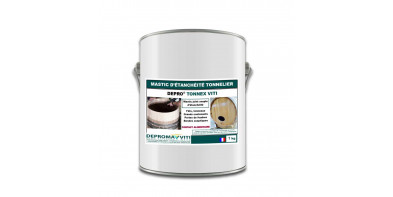



- News
- oak cask, oak casks, cooper, cooperage
Problem identified: Leaks in certain staves of large wooden vessels
Objective: Help control and reduce leakage.
Recommended product: DEPRO CHOC CONTACT (suitable for food contact)

This operation falls outside the traditional use of cooperage vessels and should therefore be considered an exceptional technical adaptation.
To date, there is no standardised method available to guarantee the integrity of the coating system in this type of application.
This is a remedial approach that cannot guarantee a perfect result but is carried out in accordance with recognised professional practices.
Although the resin has very limited tolerance for flexing, this method is intended to treat leaking areas effectively by adapting the application technique to the physical constraints of the vessel.
Given the various sealing attempts already carried out, particularly using paraffin, we propose two intervention methods, both involving the same initial surface preparation.
Preliminary surface preparation
Regardless of the method selected, substrate preparation is essential to ensure good resin adhesion.
In particular, it will be necessary to identify precisely the staves and areas where leaks occur, completely remove any paraffin residue and any other substances that could compromise adhesion, carefully sand the affected surfaces, and ensure that the wood is perfectly clean, sufficiently dry and ready to receive the resin in accordance with the instructions in its technical data sheet.
Given the height of the staves, it may be preferable to treat a sufficiently large area, or even the entire length of the affected staves, rather than limiting the application to the identified leak points.
1. First option: application of two coats of resin
This first method consists of applying a localised protective coating.
Once the substrate has been prepared:
- Apply a first coat of resin to the affected area, extending well beyond the leak points on both sides to provide an adequate safety margin.
- Observe the drying or recoating time specified in the technical data sheet.
- Apply a second coat over the entire treated surface, ensuring sufficient coverage around vulnerable areas.
The objective is to create a continuous protective film capable of sealing the identified leaks.
2. Second option: application of resin reinforced with glass fibre fabric
This second method may be considered when leaks at the joints between staves are more significant or when these joints are likely to undergo slight deformation, particularly due to the gradual deterioration of the wood caused by repeated impregnation with the leaking liquid.
This solution involves incorporating glass fibre fabric into the resin system to provide localised reinforcement, similar to a repair scrim.
The proposed application procedure is as follows:
- Prepare the surfaces according to the recommendations outlined above.
- Apply a first coat of resin, extending well beyond the leaking areas.
- Position a suitable glass fibre fabric (160–300 g/m²) on the still-wet coating, then thoroughly impregnate it with resin to ensure proper integration, without folds or air bubbles.
- After the appropriate recoating interval, apply an additional coat of resin to completely cover the reinforcement and create a continuous surface.
The purpose of this reinforcement is to improve the mechanical strength of the system in weakened areas.
Recommendations and precautions
Both methods are technically feasible repair solutions. However, neither corresponds to a repair procedure specifically standardised or validated for this type of wooden vessel.
It is therefore essential to carry out a preliminary test on a representative area to assess adhesion, compatibility with the substrate and sealing effectiveness.
Conclusion: We would initially recommend the two-coat application method, as it is simpler to implement, provided that the micro-leaks are limited and the substrate is sufficiently stable.
The glass fibre-reinforced solution could be considered if the leaks or affected areas are more significant, more extensive or concentrated in areas where the wood has deteriorated.
The materials used — oak and epoxy resin intended for contact with hydroalcoholic liquids — are well known and their properties are well understood. Combining them in this context requires a considered compromise between waterproofing performance, chemical inertness and the ability of the substrate to accommodate movement.
This approach may provide an effective solution to a specific need for isolating wood from wine under particular circumstances.
It is not a standardised solution, but rather a technical approach that warrants testing and adjustment if necessary.
Cooperage Technical Department
Are you looking for a solution to protect or renovate storage tanks, or simply to ensure that your existing tanks comply with food-contact requirements?
Contact Deproma-Viti, and we will provide you with a quotation for the supply of a resin coating specifically designed for wine tanks.
Phone: +33 (0)2 48 62 01 50 | Email: contact@deproma-viti.fr
Related products

